
Four birds were dead and three more appeared seriously affected on a small mud island in Mallacoota Inlet on Sunday afternoon. The incident has been reported to Victorian authorities, but there is currently no confirmation that bird flu was responsible.
While flying and filming around Mallacoota Inlet on Sunday, 20/09/2026, I noticed something disturbing on one of the small mud islands immediately off the Foreshore Park.
Several Crested Terns were lying on the mud. On closer observation, four were dead. Another bird appeared very sick, while two more were alive but seemed too weak to fly away. In all, seven birds in a very small area were either dead or showing obvious signs of distress.
The birds appear from the photographs to be Greater Crested Terns, with their characteristic black crest, grey and white plumage and long yellow bill.
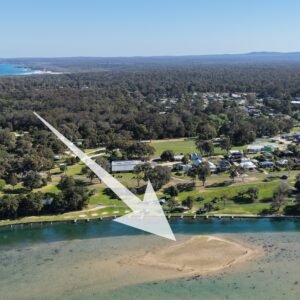
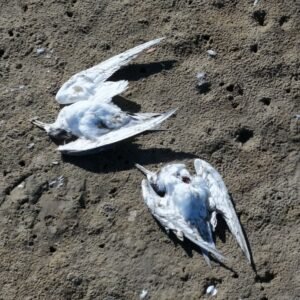
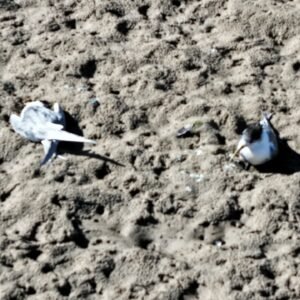
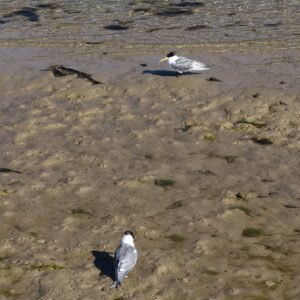
I photographed the birds and their location but did not touch or approach them unnecessarily.
The incident has been reported
I reported the cluster through the Victorian Government wildlife mortality reporting system. DEECA has confirmed receipt of the report under reference 260920-261. The department reviews reports and decides whether investigation, collection or laboratory testing is required. It also warns that not every reported mortality event will result in birds being collected or tested.
That distinction matters. At the moment, there is no evidence that these particular birds died from avian influenza.They have not, as far as I know, been tested.
However, the circumstances are worth reporting because H5N1 highly pathogenic avian influenza, commonly called H5 bird flu, is now established in wild birds in Victoria. Agriculture Victoria currently asks people to report even one sick or dead seabird, waterbird or shorebird.
Why bird flu is an obvious concern
Greater Crested Terns are particularly relevant because Victoria's first reported H5N1 detection in July was in a Greater Crested Tern found at Portland.
The disease has since been detected much more widely in Australian wildlife. As at 18/09/2026, the Australian Government reported 583 confirmed H5 bird-flu wildlife events nationally, including 184 in Victoria. An "event" can involve one or more animals, so these figures are not individual bird counts.
That does not mean the Mallacoota birds had H5N1. Birds die for many reasons, and only appropriate laboratory testing could establish the cause. What makes this observation notable is the concentration: four dead birds together, accompanied by another obviously sick bird and two apparently too weak to fly.
For anyone walking around the lake, Agriculture Victoria's advice is simple: do not touch sick or dead wildlife, avoid direct contact, record what you see and report it. A statewide control order is also currently in place governing the handling and disposal of dead wildlife on public land.
The Victorian Department of Health says the current risk of H5N1 to people in Victoria remains low and that locally acquired human infections with this strain have not been reported in Australia. Nevertheless, people should avoid handling sick or dead birds.
A strange contrast on a beautiful spring day
What made the discovery particularly striking was the setting.
It was one of those exceptional Mallacoota spring days when summer suddenly seems very close. The sky was completely clear and deep blue. The inlet was extraordinarily clear, with sunlight penetrating the shallows and the sandbanks glowing beneath the water.
Elsewhere around the lake there was life everywhere.
Pelicans drifted across the water. A large flock of sulphur-crested cockatoos swept across the landscape. People were kayaking, swimming and fishing. Boats moved through the inlet, including one heading out towards Gabo Island. Beyond the lake, the ranges faded into blue beneath a cloudless sky.
I had the drone up filming it all.
And that created an odd contrast. In one small corner of this remarkably healthy-looking landscape were seven birds in serious trouble. A few hundred metres away, it looked like the first day of summer had arrived early.
Summer's On Its Way
Rather than make the main video about dead birds, I decided to make the wider film about the day itself.
The accompanying original song, “Summer's On Its Way”, is a slow, lazy jazz-blues piece about one of those afternoons when nothing seems particularly urgent. It isn't intended as a travelogue. The pelicans, clear water, cockatoos, swimmers, fishermen and distant boats simply drift through it.
The thought behind the song is much simpler:
Maybe peace is not a destination,
Maybe no one ever gets that far,
Maybe it's an ordinary Sunday,
And noticing exactly where you are.
And perhaps my favourite line:
Someone's heading for the horizon,
I've got nowhere I need to be.
The sick terns are part of what happened at Mallacoota on 20 September, and they deserve to be documented and reported. But they weren't the whole day.
The rest of the lake was alive, clear, blue and warm, with that unmistakable feeling that summer is on its way.
Watch: Summer's On Its Way | Mallacoota Inlet in Spring
Original music and drone footage filmed at Mallacoota, Victoria, 20/09/2026.
#Mallacoota, #MallacootaInlet, #CrestedTern, #BirdFlu, #H5N1, #EastGippsland, #Wildlife, #DroneVideo, #OriginalMusic, #JazzBlues, #Spring, #GaboIsland

Screenshot
